A leaking underground water pipe does not always mean losing the entire driveway. Accurate detection can identify the fault, while trenchless moling may install a replacement pipe through small access points. This guide compares moling with open excavation, explaining disruption, suitability, cost and the questions homeowners should ask first clearly.
A hidden leak beneath a paved drive can cause low pressure, unexplained water use and damage to surrounding ground. The first task is locating the problem accurately, not immediately choosing how to dig. Professional leak repair services can assess the pipe route, identify the fault and decide whether a local repair or full replacement is more sensible. Trenchless moling often reduces surface disturbance by creating an underground bore between small access points. Open excavation still has an important role when ground conditions, access or the damaged pipe makes direct exposure the safer and more practical option for the property owner.
1. Find the Leak Before Choosing the Method
Low water pressure, pooling water, damp ground and an unusual rise in metered use can suggest a leaking supply pipe. These signs do not reveal the precise location or cause.
Specialist leak detection can reduce unnecessary digging by tracing the supply route and narrowing down the affected area. The contractor can then assess the pipe material, condition and accessibility.
A single isolated defect may be repairable. Repeated leaks, corrosion or an ageing lead supply pipe may make replacement a better long-term choice.
2. How Trenchless Moling Works
Impact moling uses a specialist pneumatic or hydraulic tool to form a narrow underground bore. A new supply pipe can then be installed along the planned route without opening one continuous trench.
The method is often described as “no-dig”, but some excavation is normally required. Small launch and receiving pits provide access at each end and at necessary connection points.
Moling can pass beneath driveways, paths, gardens and landscaped areas. It is particularly useful where protecting the finished surface is a major concern.
3. When Open Excavation Makes Sense
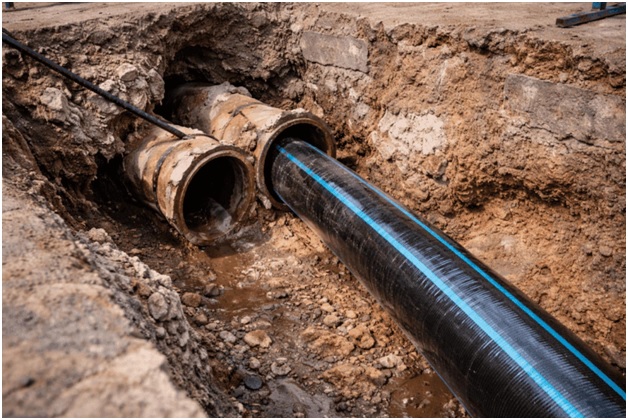
Traditional excavation exposes the pipe by digging a trench or opening the ground around the damaged section. This gives the contractor direct access for inspection and repair.
It may be the better option for a short, shallow pipe run or a fault in an easily reached area. Direct excavation can be practical when the affected surface is soil or another material that is simple to reinstate.
Obstacles, unsuitable soil or limited space for moling equipment may rule out a trenchless approach. The correct method should follow a site assessment rather than a general preference.
4. Compare Surface Disruption Properly
Moling usually disturbs a smaller surface area because the driveway does not need to be opened along the full pipe route. This may reduce reinstatement work and shorten the period during which access is restricted.
Experienced leak repair services should explain where access pits will be placed, how large they are likely to be and which surfaces will require repair afterwards.
Excavation creates more visible disruption, but it gives full access to the existing pipe. Ask for a written scope showing excavation, waste removal and reinstatement so both quotations can be compared fairly.
5. Look Beyond the Initial Price
The lowest installation quote may not represent the complete project cost. Driveway lifting, spoil removal, replacement paving and landscaping can add considerably to open excavation.
Moling may require specialist equipment and experienced operators, yet reduced reinstatement can offset part of that cost. Savings depend on the pipe length, ground conditions and surface value.
Ask each contractor to separate detection, pipework, excavation, connection and reinstatement costs. Confirm whether VAT and any water-company requirements are included.
6. Check the Proposed Pipe Route
A new supply pipe does not always need to follow the failed line exactly. Redirection may avoid difficult ground, old structures or areas that would be costly to disturb.
The contractor should assess existing utility routes before work starts. Gas, electricity, drainage and communication services can affect the safe path.
Provide any property plans you hold, but do not assume old drawings are completely accurate. The final route should be surveyed and marked by the contractor.
7. Ask About Testing and Certification
Once the work is complete, the new or repaired supply should be checked for leaks and satisfactory operation. The contractor should explain any flushing, pressure checks or connection procedures required.
Ask what paperwork will be issued and whether the work can be self-certified where applicable. Your water supplier may need documentation, particularly when a supply pipe is replaced.
Keep the quotation, photographs and completion records. They can be useful for future maintenance, insurance questions or property sales.
FAQs
Can every water-main leak be repaired by moling?
No. Suitability depends on the pipe route, ground conditions, access, obstructions and the type of repair required.
Will trenchless work leave the driveway untouched?
Not completely. Access pits and connection points usually require limited excavation, but a continuous trench may be avoided.
Is repairing one leak better than replacing the pipe?
It depends on the pipe’s age, material and general condition. Repeated failures may make full replacement more sensible.
Who owns the leaking water pipe?
Responsibility depends on where the leak sits within the supply network and property boundary. Confirm ownership with the water supplier.
How should two quotations be compared?
Compare detection, pipe length, excavation, new materials, connections, testing, waste removal and surface reinstatement.
Closing Remarks
Trenchless moling can replace an underground water supply pipe while preserving most of a driveway, path or garden. It works by forming a bore between limited access points rather than opening a continuous trench. This can reduce disruption and reinstatement, but it is not suitable for every site.
Open excavation remains valuable where the pipe is shallow, the fault needs direct inspection or ground conditions prevent accurate moling. A good decision begins with precise leak detection and a survey of the route, surfaces and nearby utilities.
Homeowners should request a written scope covering access pits, pipe material, connections, testing, certification and reinstatement. Comparing the complete cost is more useful than looking only at the repair price. By choosing qualified leak repair services and asking how the proposed method fits the property, owners can resolve a leaking water main without accepting more excavation than the job genuinely requires.